
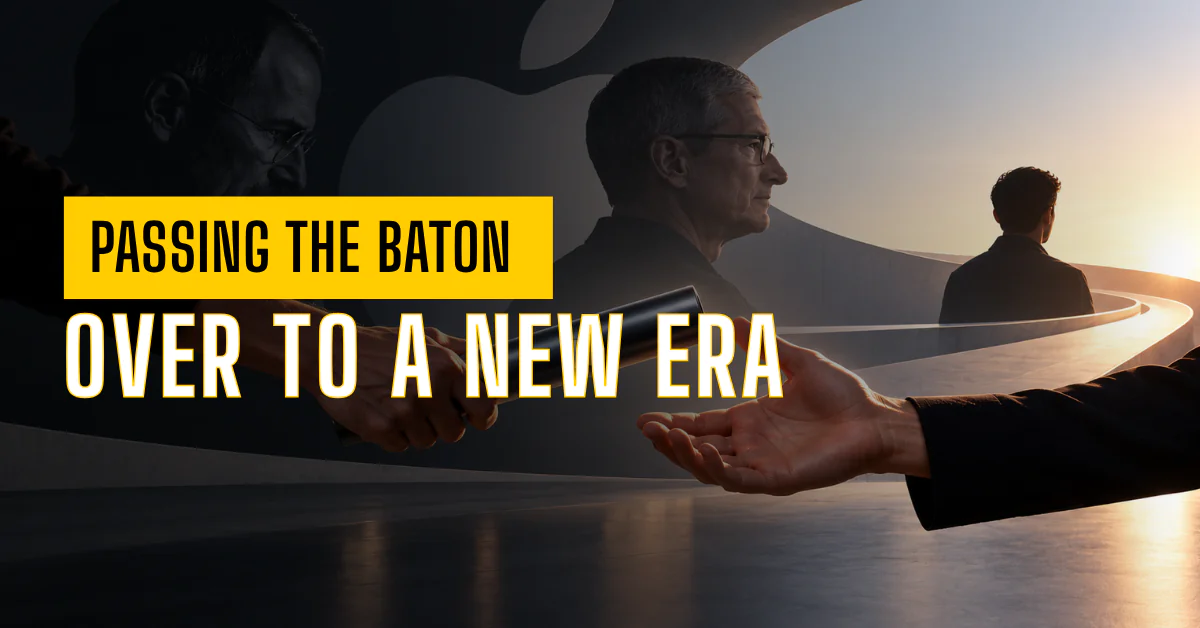
Passing the Baton Over To A New Era
When Steve Jobs passed away on October 5, 2011, the then President of the United States Barack Obama wrote ‘The world has lost a visionary. And there may be no greater tribute to Steve’s success than the fact that much of the world learned of his passing on a device he invented. ‘ A lot of people could relate to this tribute. These were not easy shoes to fill and many also had questions on the future of Apple. No matter how successful a company is, transitions can be challenging and the future is never guaranteed. There are numerous examples for this (IBM, Blackberry, GE and more). However Steve had identified a successor prior to his passing. Tim Cook took over as CEO on August 24, 2011.
On September 1, 2026, Tim Cook stepped away from one of the most valued positions in the world for the last time as Apple’s CEO. Fifteen years earlier, he had inherited a company still reeling from the loss of its founder. Many people at that time could not imagine anyone taking on the role. Cook proved them wrong with a decade and a half of quiet stewardship. Under his watch, the company continued to grow into one of the most valued enterprises today.
We tend to celebrate the taking of power more than the giving of it, like a founder who seizes the reins, or an executive that fights their way to the top. But the harder, rarer act is knowing when your hands have done their work, and choosing to open them. Another great example of this is Natarajan Chandrasekharan the CEO of TATA Sons who chose not to seek a reappointment as Chairman after his term comes to an end.
Cook didn’t lead in the same style of fashion as his predecessor. He led through operations, discipline, and an almost invisible kind of steadiness. Not every era of leadership has to look like the one before it. What matters is whether what you’re leading is stronger when you leave than when you arrived.
That’s really what passing the baton means. In a relay, the runner whose finishing doesn’t slow down to hand off cleanly. They’re at full speed, and the exchange happens in motion, while everything is still working. The worst handoffs happen when a leader waits too long, clutching the baton until their legs give out and the whole team stumbles with them. The best ones happen while the run is still strong, when there’s still room to trust the next person to carry it further than you could have alone.
One may argue that Apple is stronger than before or also a counter argument that there are not many new inventions happening at Apple. But Tim Cook did his job well and it is for the new leadership to determine what is next. Could he have done more? The answer is always yes, not just for Tim Cook but even for Steve Jobs. Every leader is different.
Cook’s successor, John Ternus, spent twenty-five years learning the company from the inside, specifically in design and hardware engineering. Not only was this next era of leadership nurtured from within the company, but he is bringing in experience based on a different blueprint than those before him.
John’s LinkedIn profile is very interesting. More than what LinkedIn says, what we deliver is more important.

Becoming a leader doesn’t happen in a single, glamourous moment. It’s a slow accumulation of trust, built long before anyone announces a transition: in the people you mentor, the decisions you let others make, and the credit you’re willing to share.
As a leader, ask yourself: are you building something that needs you, or something that can eventually run without you? The first kind of leadership feels good in the moment. The second kind is what actually lasts.
The baton never really stops being passed. New generations will come, threatening not only fresh ideas and high energy, but also potentially better leadership than yours. The only real question is whether you hand it off while it’s still gaining speed.
Thank you for Reading,
Karthik Chidambaram





Leave a Reply