
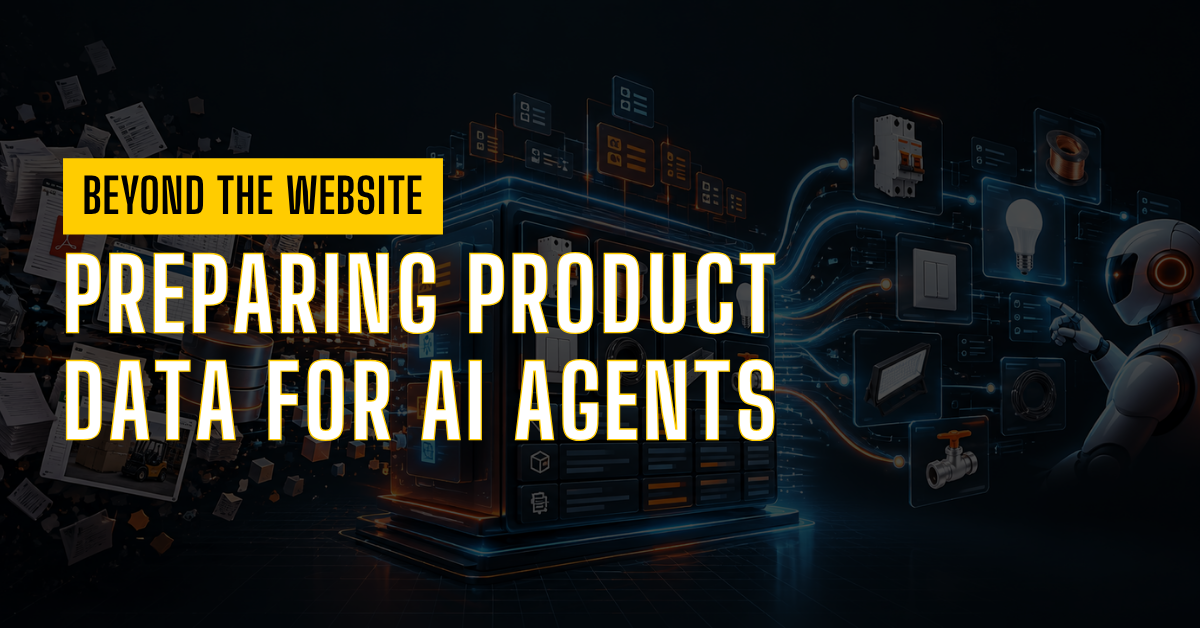
Beyond the Website: Preparing Product Data for AI Agents
A recent conversation with Patrick Knight, CEO of IDEA (Idea4industry) , shows how a long-standing challenge has become newly urgent. That challenge is product data. IDEA has spent nearly three decades helping electrical manufacturers and distributors make product information consistent, accurate and usable across systems.
Why the Electrical Industry Owns Its Data and What’s Coming Next | Patrick Knight, IDEA
From Website to AI Agent
For years, the distributor’s website has been acting as the new branch. However, the next point of contact with a customer may not be the website at all. It may be an AI agent. OpenAI’s March 2026 expansion of product discovery in ChatGPT and its Agentic Commerce Protocol signal the shift.
Websites were built for people, and people are forgiving. For example, an experienced buyer can understand that “operating temperature” with “temperature range” operationally mean similar things. An AI agent cannot rely on that intuition. It does not browse a polished product page. It reasons over data to decide whether a product meets a precise request.
Incomplete or inconsistent data leaves a product present but effectively invisible. The question for distributors has changed. It is no longer “Can my customer find this product?” It is “Can a machine correctly understand it?”
Why Standards Matter
Knight recalls manufacturers complaining that distributors displayed their data incorrectly, while distributors complained of poor data in thirty different formats. That tension persists today.
AI turns standardization from housekeeping into strategy. When ERP systems, PIMs and AI agents all rely on the same information, a common product language is essential. Standards such as ETIM support this goal. Having managed vast technical catalogues for decades, the electrical industry holds a meaningful head start.
Data Readiness as Competitive Advantage
The next differentiator may be how easily machines understand a distributor’s products. Shopify reports that AI-generated traffic to its stores grew eightfold year over year in Q1 2026. Orders from AI-powered searches rose nearly thirteenfold. B2B buying is more complex, but the direction is clear.
5 Questions Before You Begin
Before pursuing an AI commerce strategy, distributors should assess their existing data:
- What are the main sources of product information?
- Which system is authoritative for each attribute?
- How much data is trapped in PDFs or spreadsheets?
- How consistently are names, variants, prices and availability represented?
- Can a machine understand the catalogue without human explanation?
Better data improves search, integrations, analytics and customer experience. The digital shelf may be becoming invisible, but the data behind it matters more than ever.
Thank you for reading.
Karthik Chidambaram.





Leave a Reply