
Languages will prosper in the AI era If….
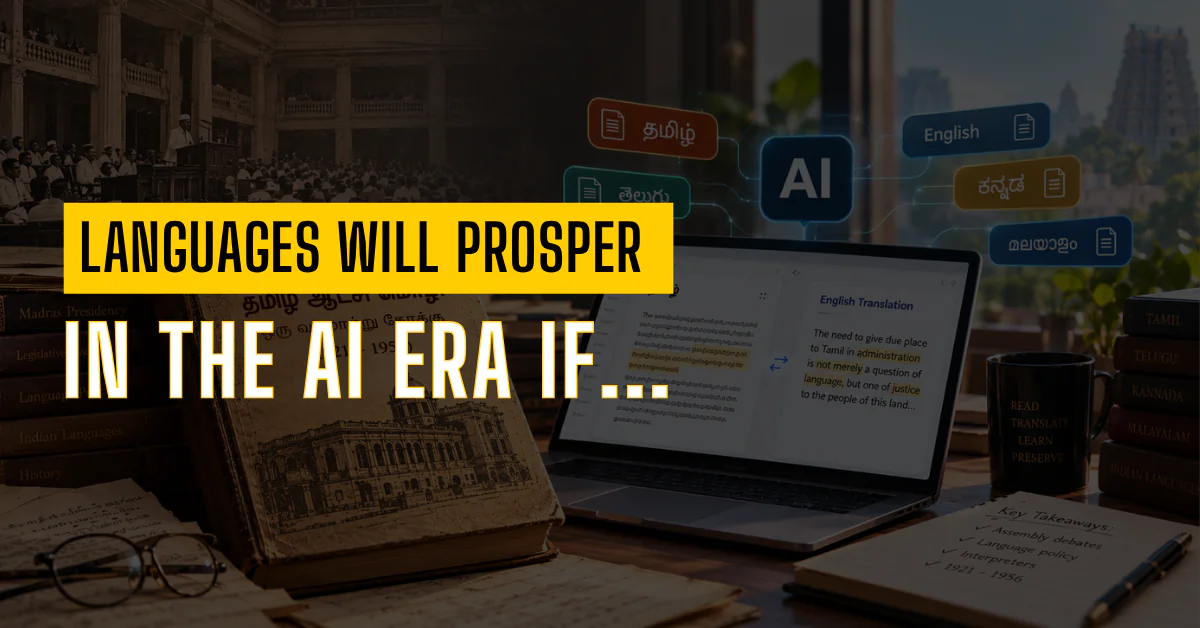
Recently, I read a book written by D. Sundaresan, titled தமிழ் ஆட்சி மொழி – ஒரு வரலாற்று நோக்கு (1921–1956) (lit. Tamil as an Official Language – A Historical Perspective (1921–1956)). The book is more than 360 pages long. It chronicles the speeches of different members of the Tamil Nadu Legislative Assembly from 1921 to 1956: documenting the journey of the Tamil language from being recognized as a regional language to the official language of governance in Tamil Nadu.
I enjoyed the book, as it was relevant to some of the research I’ve been doing in this space. I found the speeches of different people whose names we see in history books and newspapers very interesting. It was also good to understand what happened 100 years ago to get a perspective of things today.
I found this book on Archive.org. I highlighted the parts I loved as I was reading, but missed doing that for the first 150 pages. Later, I started marking them down. Usually, when I read a book, I publish my notes on my blog, so even if no one else reads them, I can always go back and refer to them later.
I was trying to do the same thing for this book as well. Then I thought it would help if the content were also in English, as not everyone reads the local language today (unfortunately). I used Claude’s help. I prompted that I was writing a blog and needed the passages I had marked, with the appropriate English translation side by side. Initially Claude told me that it could not read the book, and then it asked me to upload the text version or pdf. It also told me where exactly to find it on Archive.org. I followed the instructions and did exactly what it asked me to do to get it started. Claude then did the work.
When I copied some of the highlighted versions to the notepad, I forgot the page numbers. But Claude took care of all this. It found the exact page numbers of my text, also found the date the speaker spoke etc. For the first 150 pages, I told Claude, I missed highlighting the important pieces, so can you use my pattern and find what is relevant text in the first 150 pages. Claude did it. Again, all of this text was in Tamil and Claude was able to comprehend this.
I added my introduction and asked Claude to make it publishing ready. Claude did the work and overall it took me 3-6 hours playing with it, but I thoroughly enjoyed the experience.
It’s very interesting to think about it.
In the 1920s, before independence and the emergence of the state of ‘Tamil Nadu’ as we know it today, it was the Madras Presidency, and Tamil wasn’t the only main language spoken in the region. English was the only official language. As a result, there were wide debates in the assembly about the need for interpreters. English speeches needed interpreters to be translated to Tamil, Telugu, Kannada, Malayalam and the like. Tamil speeches needed interpreters, and all of those speeches needed to be translated to English. Some even argued about the costs involved.
Fast forward 100 years later, and how much things have changed. You are able to interpret and translate then and there. Research becomes easier. Language is no longer a barrier.
In many ways, languages, especially Tamil and many other Indian languages, missed the bus during the internet revolution, but this time around, we can’t afford to miss out on what’s happening with AI.
Languages will prosper in this era if we capitalize on the opportunity at hand. If you would like to read more about the genuinely interesting history behind Tamil’s status as the state’s official language and also see the document Claude created, you can check my blog here.
Thank you for reading.
Karthik Chidambaram.




Leave a Reply