
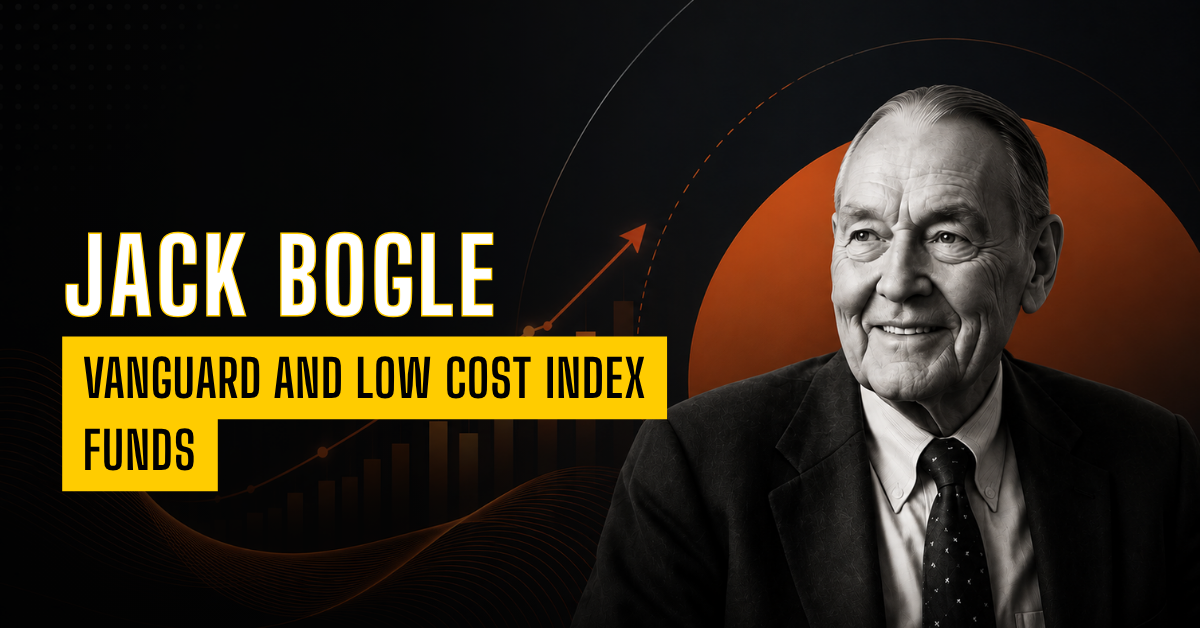
Jack Bogle, Vanguard and Low Cost Index Funds
I first learned about Vanguard over ten years ago after reading Andrew Tobias’s classic book, The Only Investment Guide You Will Ever Need. When I needed to set up my 401(k) and invest in the S&P 500, I didn’t overthink it; I just chose Vanguard.
In his 2016 letter to Berkshire Hathaway shareholders, Warren Buffett even wrote: “If a statue were ever erected to honor the person who has done the most for American investors, the hands-down choice should be Jack Bogle.”
Over the years, I’ve followed the story of John “Jack” Bogle, Vanguard’s legendary founder. When he passed away in 2019, it actually felt like a personal loss. A few weeks ago, I listened to a deep-dive episode on Vanguard on the Acquired podcast, hosted by Ben Gilbert and David Rosenthal
From Getting Fired to Founding Vanguard
Like many great startup stories, Bogle’s path wasn’t smooth. As a founder, you go through a lot of ups and downs, and Bogle was actually fired from his position at Wellington Management after a merger went wrong.
Instead of walking away, he started Vanguard in 1975. He mutualized the company structure so the customers are the owners. Because there are no outside shareholders demanding a cut of profits, Vanguard runs on razor-thin margins and passes those savings directly back to customers in the form of ultra-low expense ratios.
Net Worth of Jack Bogle
One of the most mind-blowing takeaways from the episode was Bogle’s personal net worth. Had Bogle structured Vanguard like a traditional Wall Street firm (taking standard management fees and keeping equity for himself), he easily could have been worth billions. Instead, because of his commitment to customer ownership, his net worth at his death was around $90 million.
Bogle’s Folly and the Anti-ETF Stance
When Vanguard launched the very first index fund for retail investors in 1976, Wall Street laughed at it. They aimed to raise $150 million and only managed $11.3 million, labeling it “Bogle’s Folly.” Today, that index fund alone holds over $1 trillion, and Vanguard manages roughly $9 trillion across all its funds.
Interestingly, Bogle was strongly opposed to Exchange-Traded Funds (ETFs) for a long time. Even though Vanguard today offers massively popular ETFs like VOO, Bogle believed that being able to trade index funds minute-by-minute during market hours turned long-term investing into short-term speculation.
This year, Vanguard’s ETF VOO has made history as the first ETF to surpass $1 trillion in assets under management.
Thin Margins Trade-off
As Ben and David pointed out on Acquired, operating on such thin margins comes with a side effect: Vanguard doesn’t spend big on technology. If you’ve ever used the Vanguard website, you’ve probably noticed this firsthand. The site can be difficult to navigate, and you are also not able to sell specific lots in some cases (which is a pain).
Looking to the Future
Today, the financial landscape is changing. You can buy Vanguard funds on almost any trading platform, and competitors like Fidelity and BlackRock offer their own low-cost index funds. Vanguard isn’t the only cheap option anymore, but they are the reason low-cost investing exists in the first place. Vanguard now also offers fund managers to manage your funds. It will be very interesting to see how Vanguard evolves from here.
Thanks Ben & David for the 4-hour episode on Vanguard. Thanks Vanguard for transforming the industry.
And thank you for reading.
Karthik Chidambaram.





Leave a Reply