
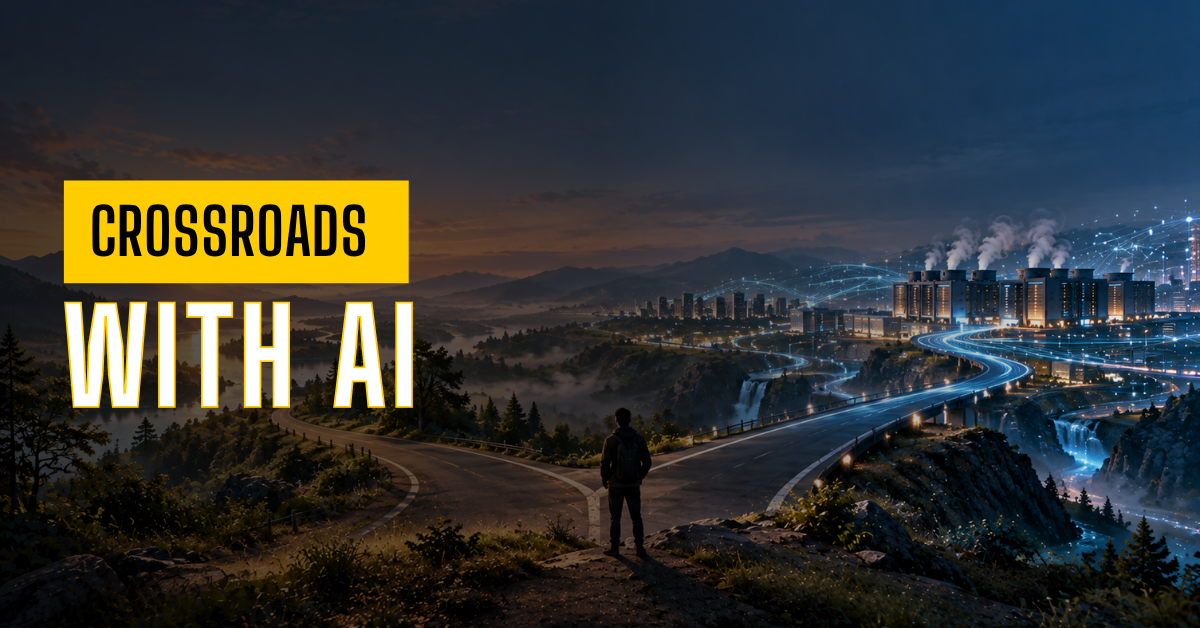
Crossroads With AI
In several recent meetings, the use of AI and how it is disrupting our work has been discussed.
We also talk about how, if we want to stay relevant, we need to embrace change.
But recently a friend of mine shared some stats which led me to also do a bit of reading on my own: what happens when we start looking at AI from an environmental perspective? Why does it matter? How does it impact us? And, perhaps most importantly, is the way we are growing AI today sustainable?
I am not an expert and I do not have all the answers. But here are some thoughts. When you ask AI a simple text question, the energy consumed may be roughly equivalent to turning on a microwave for about a second. That doesn’t sound like much. But then think about what happens when we start generating images, videos, and increasingly sophisticated content. A small, five-second AI-generated video can consume several litres of drinking water in the associated computing and cooling processes. A 15-second clip can consume energy comparable to charging your phone many times.
These numbers can quickly add up. Every image and video we generate carries a real resource cost: electricity, water, computing infrastructure, and hardware. One image may not seem like much. And one five-second video may not seem like much. But what happens when millions of people start generating them repeatedly? And perhaps the bigger question is: what are we using these resources for?
We have spent years telling our children to turn off the lights when they leave a room. We tell them not to waste water. We tell them to conserve resources. Yet, we are building systems that consume enormous amounts of electricity and water, sometimes to generate content that has very little value beyond a few seconds of entertainment. Generating an AI image can, depending on the model and infrastructure, have an energy footprint comparable to running a 10-watt LED bulb for several hours.
There is a real cost behind the magic.
AI feels almost magical. We type a prompt, and seconds later an image appears. We ask a question, and an answer appears. We generate a video, and something that would have taken hours of work can appear almost instantly, as if from thin air. But behind that magic are data centers, GPUs, electricity, cooling systems, water, physical infrastructure and an enormous supply chain.
As Adam Zewe wrote in an MIT News Explained article, the computational power required to train generative AI models with billions of parameters can demand staggering amounts of electricity, increasing carbon dioxide emissions and putting pressure on the electric grid.
A great deal of water is also needed to cool the hardware used for training, deploying and fine-tuning generative AI models. So when we say, “It’s just an AI-generated video,” perhaps we should remember that there is no such thing as “just” an AI-generated video. There is a resource cost behind it.
Rachel Carson, an American marine biologist who is widely regarded as one of the people who helped launch the modern environmental movement, once wrote about the danger of technological progress without questioning whether everything we can do is something we should do:
“The age of technology… if we know how to do something, we do it without pausing to inquire whether we should.”
The question feels particularly relevant today: Should we stop AI?
No. Advocating for an outright halt to Gen-AI development is impractical. AI has enormous potential. It can improve productivity. It can accelerate scientific research. It can help doctors, engineers, teachers and businesses. It can potentially solve problems that humans have struggled with for decades. The question isn’t whether we should develop AI.
We need an impact evaluation.
Perhaps every major AI application should be evaluated not just on what it can do, but also on what it consumes.
What is the environmental cost?
How much electricity does it require?
How much water?
What hardware does it require?
How long will that hardware last?
Does it require specialized hardware that becomes obsolete quickly?
What happens to the hardware when the next generation of AI arrives?
How does AI integration into devices and operating systems affect overall consumption?
Is there a more efficient way to back the power of Gen-AI?
And perhaps most importantly:
What meaningful benefit are we actually getting in return?
Sooner or later, this is bound to happen. We have seen periods of rapid expansion in technology before.
The dot-com boom. There was enormous excitement, enormous investment and enormous growth. And some of those technologies created tremendous value. But they also created boom-and-bust cycles. Could we be making the same mistake with AI? And who gets to decide what is worth it?
Much of the existing literature around AI ethics, policy and technology comes from wealthy countries. That creates a risk that the conversation disproportionately reflects the needs and economies of wealthy countries. But the priorities of the Global South can be very different. For someone with abundant electricity and water, generating another AI video may seem harmless. For someone living in a place where water is scarce, the equation may look very different. Should the world really have one definition of technological progress? Or should we be asking who benefits, who pays the cost, and who gets to decide?
At present, our understanding of both the direct and indirect impacts of digitalization on energy use, carbon emissions and potential mitigation is still limited. That itself should make us cautious. We are scaling something enormously quickly while we are still trying to understand its full consequences.
So, will this AI growth be sustainable?
I don’t know.
And perhaps that’s the point.
We should be asking the question.
We have spent a lot of time talking about how AI will change our jobs.
We talk about productivity, about efficiency, about disruption, or about how we need to embrace change to stay relevant.
But perhaps we also need to ask this question as well:
What is the environmental cost of all this progress?
And ultimately:
Will this AI growth be environmentally sustainable?
New Innovations will be on the way.
Thank you for reading.
Karthik Chidambaram.





Leave a Reply