
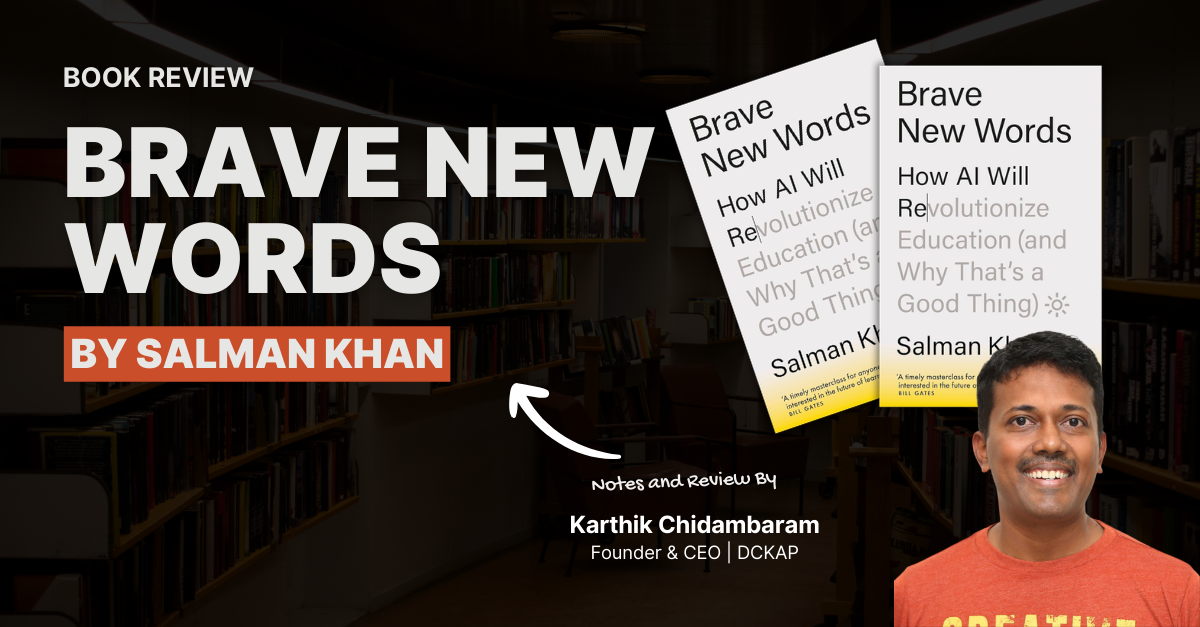
Brave New Words – Salman Khan
There’s a lot of talk about AI and how it will disrupt many disciplines, including education. So when I first heard about Brave New Words: How AI Will Revolutionize Education by Salman Khan, founder of Khan Academy, I wanted to read it. This book helped me think differently about and truly visualize the future of education.
We all know Sal and the revolutionary work of Khan Academy. When the internet became widespread and YouTube launched in 2005, Khan Academy soon followed, offering free tutoring for students through online videos. The impact was disruptive—great, quality lectures reaching millions, often with explanations better than what you’d find in many classroom settings. Yet Khan Academy didn’t replace teachers. It aided them in doing a better job. Many teachers began watching Khan Academy lectures themselves and incorporating them into their teaching. It simply made their jobs easier.
The same could be said for AI in education. Sal Khan and his team got early access to ChatGPT even before its public launch, and Sal was blown away by the possibilities. In his book, Sal writes about the one-to-many education system (the public education system that started in the 18th century) and presents it as utopian. But according to Sal, one-on-one tutoring works far better than one-to-many. Every student needs a specific kind of learning, and it needs to be customized. Students get better attention and learn more effectively with personalized coaching. Today, however, only the wealthy or upper-middle class can afford such a luxury. With AI, everyone can have a personalized tutor tailored to their needs. AI can also serve as a teaching assistant for teachers.
AI can be customized to each student and adjust to their individual learning pace. The problem with AI in its current form is that students can simply get answers to every question. But what if AI started questioning the student instead? What if it could assess their understanding along the way? This is exactly what Khan Academy set out to do with Khanmigo platform, a personalized AI tutor for every student built on top of ChatGPT.
Sal Khan showcases different use cases of AI in education. He shares examples where AI works with us in creating stories. AI can also be a great history teacher. It could be Abraham Lincoln, Mahatma Gandhi, or any historic character. We could directly interact with Lincoln or Gandhi. Misinformation, however, is a challenge, and we need guardrails. In the book, Sal also shares examples of interactions with AI on how it acts as a mental health coach.
The Khanmigo platform is designed not to give answers right away. Instead, it works with students, asking them questions to ensure they’re learning the fundamentals. Based on the questions students ask and how they respond, the platform can assess their performance and ask further questions. Students need to answer these questions for the AI to proceed to the next step. Parents also have access to the AI’s interactions with their children and can see the progress being made. This AI becomes a true personal tutor for students. What was once available only to the wealthy becomes widespread—each one of us will have access to personalized learning. Sal also writes about how when working with kids, they tend to listen better to a third party instead of their parents. He suggests that an AI tutor could be that third party. (Though kids being on devices is another problem, and I’m not sure how this would work.)
AI assists teachers in preparing better for classes, just like Khan Academy did with videos. For example, if a teacher is trying to explain to students the complexity of economics that led to World War II, he or she could spend hours on research or prompt a question to AI and ask it to come up with examples to explain to students. Based on the output, the teacher could also verify from other AI platforms and prepare for the class.
The author also shares insights on homeschooling. Three million parents are homeschooling their kids in the US today. Parents become teachers. However, it’s hard for parents to know everything. This is where AI comes in to help. New models of education are also being developed. The kids being homeschooled also gather together in communities, and this helps with their social skills. In a country like the US, administering uniform education across the board—where school districts determine the quality of education a student gets—makes it a nearly impossible task. However, AI can help bridge the knowledge and skill gap among teachers.
The cost of education being spent across the world varies—not just across the world, but even within the US. Louisiana spends $10,000 per student versus $40,000 per student in New York.
The author also writes on the admission process in universities and AI’s role in it. Though we may complain about competitive exams, what are the better alternatives to measure student progress? In applying for college, students cite different projects or accomplishments but how would one know if it is they who really did them? Affluent families are able to hire coaches to help with college admissions. AI can fine-tune questions based on the skill level of students and evaluate them accordingly. An entire industry exists around college admissions, and it will be disrupted as well. The author also floats an interesting idea: what if a college AI agent talks to a student’s AI agent to understand the student’s skill level based on how they use AI?
Employment: The author shares what’s commonly said – you won’t be replaced by AI, but you might get replaced by someone using AI. An AI copilot is available today to help fill in code. The demand for engineers who are ten times more productive will increase. Generative AI will create more innovation. Even if it can generate code, we still need to understand how the pieces work together. In the film industry, AI could co-write with writers and help generate ideas. The author also writes on entrepreneurship, which is fundamentally about disruption. Yet our school system is designed for conformity – kids sitting in rows, told to make no noise, and more. Both socially and academically, nonconformity is punished. The three Rs – Reading, Writing, and Arithmetic – are more critical than ever.
With AI, access to education and information will become widespread, enabling us to produce far more Einsteins and Newtons and increasing our ability to cure diseases. The author references the 2001 film A Space Odyssey and the Star Trek movies. He also draws on his favorite book series – the Foundation Series by Isaac Asimov. In it, the galaxy is ruled by a single empire. An academic named Hari Seldon has developed a new field called psychohistory, which predicts large-scale historical trends. His science tells him the galactic empire will enter 10,000 years of war, famine, and lost knowledge. This dark age cannot be prevented, but its duration can be shortened. So he establishes a foundation at the periphery of the galaxy to preserve knowledge and technology.
The strength of a civilization does not lie in its physical size, power, or wealth. Those are byproducts of where real strength resides: culture, know-how, and mindset. The author also reflects that very few people in our society think on a scale beyond a few years or decades, much less hundreds or thousands of years.
My Take on the Book:
This book helped me visualize the future of education – how it will change and what’s ahead. Reading through it, I sometimes felt there was an overemphasis on AI and how it can be used for everything. The book also covers AI as a mental health coach, which I found interesting but harder to fully embrace. How would it feel to just talk to a machine for better health? Maybe I could have a conversation with AI, but I wouldn’t want to rely on it for everything. I’d still want to talk to a person. There’s also quite a bit of mention of Khanmigo. I hadn’t heard about the platform before, and now I know about it. Nevertheless, Sal Khan has changed the world in a big way with Khan Academy, and his perspective on the future of education was refreshing. I loved his notes on the Foundation Series and thinking about the future. I could visualize how things would change with AI. Thanks, Sal, for writing this book.


Leave a Reply