
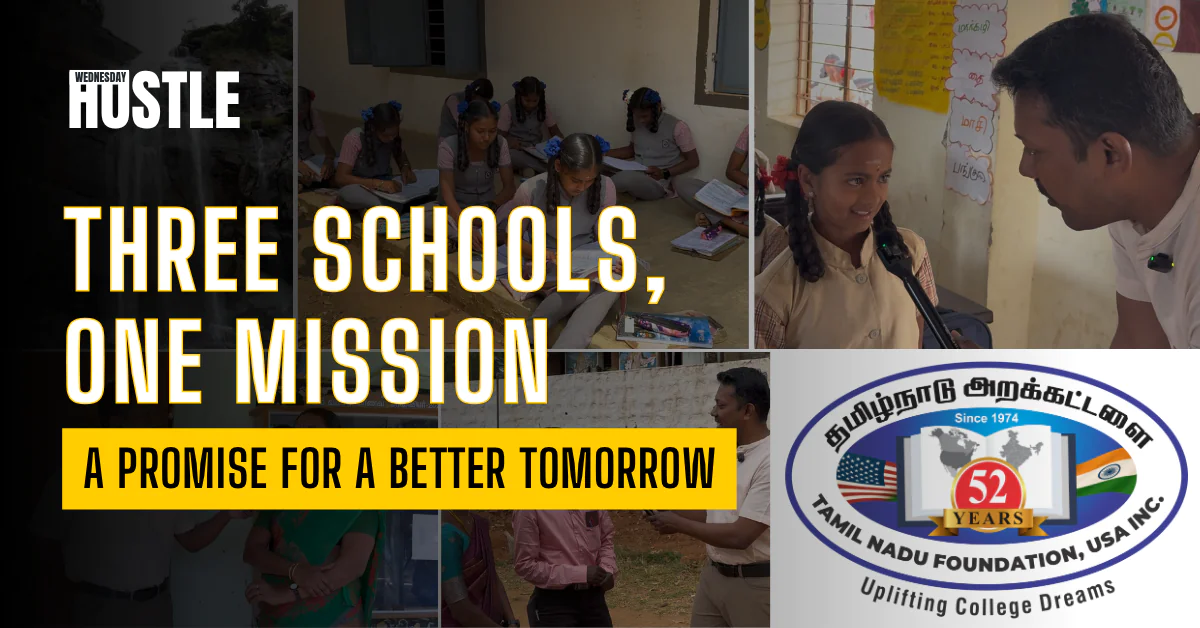
Three Schools, One Mission: A Promise For A Better Tomorrow
I had the privilege of visiting three schools in rural Tamil Nadu supported by the Tamil Nadu Foundation (TNF). If TNF sounds familiar, I’ve written about their great work before.

These visits showed me what access, opportunity, and community support can mean for children growing up in rural Tamil Nadu.
Nestled in the hills of Salem district, the Government Tribal Residential School (GTRS) at Arunoothumalai is a place where dedication meets purpose. My recent visit offered a window into a community quietly doing extraordinary work.

The school has served tribal students since 1967 and currently caters to over 280 students from grades 6 through 12, drawn from ten surrounding villages. Its remote location makes it difficult to staff, yet the campus is remarkably well-maintained — a testament to the five-year leadership of Headmistress Shanthi Esther.

One of the most memorable moments was a conversation with the Tamil teacher, Perumal, who doubles as an archaeologist and history enthusiast. He voluntarily introduces students to archaeology outside the formal syllabus — the kind of quiet passion that shapes young minds long after the lesson ends. This dedication has contributed to the school achieving 100% pass rates in board exams for the past two years.

The Headmistress offered a beautiful analogy about the TNF’s support: just as films are made possible by countless unseen hands while only the hero gets applause, the TNF works tirelessly behind the scenes. Among its contributions, the TNF’s support helped the school become a recognized board exam centre. This was a milestone that once required students to travel elsewhere.
The next stop was the ValvilOri Government Tribal Residential Higher Secondary School in Kolli Hills. We stayed at Hotel Lotus, just a few blocks from the school, and the region’s natural beauty was ever-present. Lush, green, and alive, Kolli Hills is home to the famous Aagya Gangai Falls, which draws visitors from across the state. That steady flow of tourism has quietly shaped the community in meaningful ways, and this was visible the moment I walked through the school gates.

The students were engaged, curious, and confident. The TNF teachers were in full form, energetic and warm, and clearly making a difference. There was a vibrancy to the school that was hard to miss. The children also appeared healthier, which comes as no surprise given that TNF supports students here with a morning serving of a nutritious multigrain porridge that gives them a strong start to each day.

I was fortunate to observe TNF teachers Satya and Manikandan conducting classes, and we made sure to capture those moments. The school’s headmistress, chemistry teacher Kavitha, and the rest of the staff were deeply grateful for TNF’s continued support and initiatives. Watching that partnership in action, between a dedicated organisation and a community ready to receive it, was truly inspiring.

My third visit was to Senkarai, roughly 30 kilometres from Kolli Hills. It told a different story. The contrast was immediate. Without the economic activity that tourism brings, the village is more isolated, and that isolation has a ripple effect on resources, on exposure, and on the confidence of its young people. The energy felt quieter, the needs more pressing.

When I interacted with the students and asked what could be done better, most stayed silent. Then one girl stepped forward. Her name was Durga. She said, plainly and without hesitation, that her school does not have proper water facilities and that they simply do not have enough water. It caught me off guard, but more than anything, I was moved by her courage. In a room where most chose silence, Durga chose to speak. That kind of boldness, especially from a young girl in a resource-constrained environment, deserves to be acknowledged and acted upon.
There was also a moment of quiet triumph at Senkarai. A girl supported by the TNF has cleared the competitive Joint Entrance Examination (JEE) Mains Examination, a remarkable achievement that speaks volumes about what becomes possible when young people are believed in and given the right support. It is a reminder that potential is never the limiting factor. Opportunity is.

Together, these three visits reinforced something important: development is not just about infrastructure or funding. It is also about exposure, confidence, and the belief that one’s voice matters. Tourism, economic activity, and community investment all shape the environment children grow up in, often in ways that are invisible until you see the contrast up close.
TNF is doing vital work in bridging these gaps, through nutrition, through quality teaching, and through a sustained presence in communities that need it most. The organisation does not just provide resources; it builds belief. And belief, as Durga showed me, can be the most powerful resource of all.
I am grateful to TNF for this opportunity and for the experience it made possible. I carry with me the faces of those students, and especially the voice of Durga, who reminded me that even in the quietest corners, there are bold voices waiting to be heard. That voice is leadership.
Thank you for reading.
Karthik Chidambaram.


Leave a Reply