
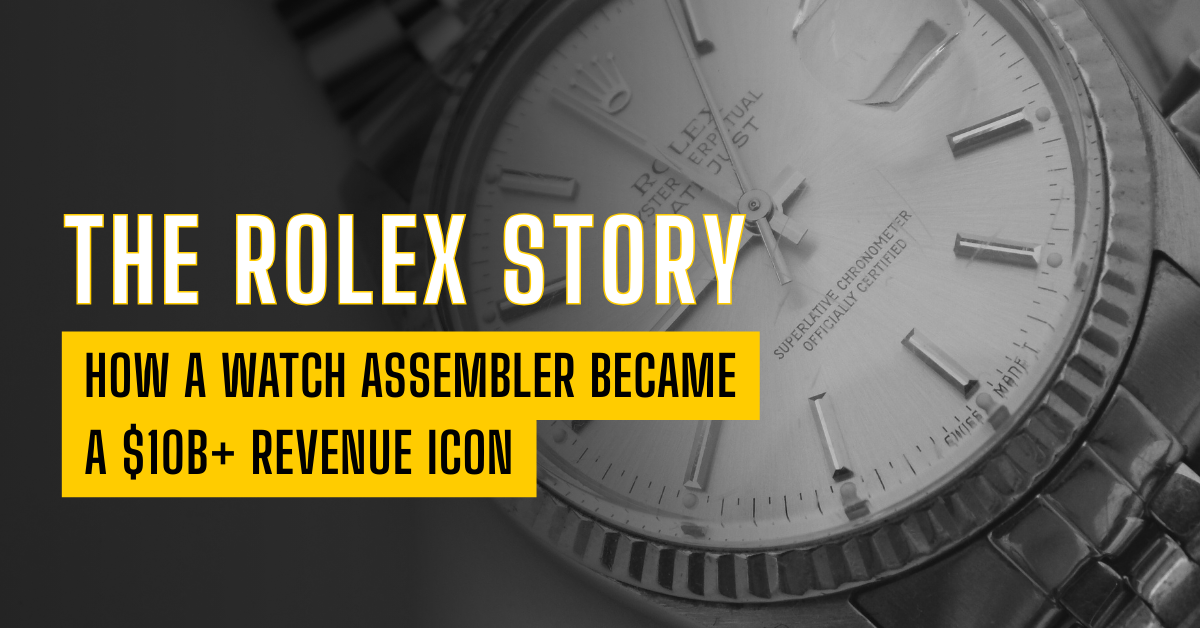
The Rolex Story: How a Watch Assembler Became a $10B+ Revenue Icon
I just finished the Rolex episode of Acquired.fm (yes, spread over a week of drives, given that it’s a 4+ hour deep dive). I found the story absolutely fascinating. Here are my key takeaways from their incredible deep dive, and what stuck with me:
A Humble Beginning
Rolex didn’t start as the luxury powerhouse we know today. In 1905, it began as Wilsdorf & Davis in London—not even in Switzerland. Founder Hans Wilsdorf was importing Swiss watch movements and assembling them locally. They weren’t manufacturing all the components; they were assemblers. Think of it like the difference between Apple designing the iPhone versus Foxconn putting it together.
How Wars Built Rolex
Switzerland’s neutrality through both World Wars turned out to be Rolex’s secret weapon. While other European manufacturers were devastated, Swiss watchmaking thrived.
But here’s the real inflection point: World War II changed how people wore watches entirely. Before the war, watches were pocket accessories: something you kept in your bag. During wartime, keeping precise timing became critical for military operations. Soldiers needed quick access to the time, so they strapped watches to their wrists. This shift created massive demand and permanently changed consumer behavior.
Post-war, Rolex had their sights set on America, which was the emerging market with purchasing power.
Brilliant Brand Building
Rolex’s marketing playbook is masterclass material:
Strategic Gifting: They put watches on the wrists of Winston Churchill and Dwight Eisenhower. Talk about influencer marketing before the term was a thing.
Hero Association: When Jacques Cousteau was pioneering scuba diving, he wore a Rolex. When astronauts went on Apollo missions, they wore Rolex watches. The brand attached itself to human achievement without claiming credit for it.
Perfect Positioning: Their advertising philosophy? “We do not change the world, we leave it to people who wear Rolex to do that.” Genius. They positioned themselves as the tool of world-changers, not the change itself.
The Business Model That Defies Logic
Here’s what blew my mind: Rolex is a $10B+ company that doesn’t own a single retail store. Everything runs through dealers. In an age of direct-to-consumer brands and vertical integration, Rolex has stuck with a distribution model that somehow still works.
Even more unusual? Rolex is 100% owned by the Hans Wilsdorf Foundation—a private, charitable entity. The foundation distributes approximately 300 million Swiss francs annually to charitable causes, divided roughly into thirds: humanitarian aid, animal protection and environmental initiatives, and local projects in Geneva. It supports education through scholarships, helps families with rent deposits, funds social welfare programs, backs cultural institutions like theaters and museums, and even assists with debt relief.
This structure has allowed Rolex to play the long game without pressure from shareholders or private equity, while also giving back to the community.
Surviving the Quartz Crisis
The 1970s saw a major upheaval in the watchmaking industry called the Quartz Crisis. It came about with the advent of battery-powered quartz watches from Japan flooding the market, which threatened the erstwhile popular, yet expensive, mechanical watches.
This Quartz movement disrupted the entire Swiss watch industry and bigger brands like Omega struggled. The Swatch Alliance emerged as a response. But Rolex? They weathered the storm, adapted and came out triumphant, merging their craftsmanship and quartz tech and creating their own answer to the crisis: the Rolex Oysterquartz. That, coupled with very smart positioning, ensured they succeeded where other brands struggled.
Initially, Rolex wasn’t even a luxury brand—it was a quality timepiece. The transformation to luxury icon came through decades of consistent brand building and product excellence.
Still Relevant in the Apple Watch Era
Despite Apple Watches, Fitbits, and every smartphone having a clock, Rolex remains extraordinarily relevant. Why? Because they’re not selling timekeeping: they’re offering the image projection of achievement, heritage, and status.
A Rolex isn’t competing with your iPhone; it’s in a completely different category.
Takeaways From The Episode
Rolex’s story isn’t about making the flashiest timepiece or the most innovative technology. It’s about:
- Strategic positioning during global shifts
- Associating with excellence without claiming to create it
- Building distribution through trust, not control
- Playing the infinite game with a foundation structure
- Staying true to craft yet adapting technology “disrupts”
In a world obsessed with disruption and innovation, sometimes the winning move is patient, consistent execution of a clear vision.
The Acquired Effect
The research Ben Gilbert and David Rosenthal do for Acquired is genuinely extensive. Their ability to synthesize decades of business history into compelling narratives is why these 4+ hour podcasts are worth the week-long commute commitment.
At a time when many may consider short-form content king, it’s exciting to see a podcast not only embrace longer formats and allow deeper dives into these great business stories, but do so with the success Acquired.fm has managed to achieve. I definitely recommend the podcast to anyone who is interested in business, strategy, branding, and more.
Thank you for reading.
Karthik Chidambaram.


Leave a Reply