
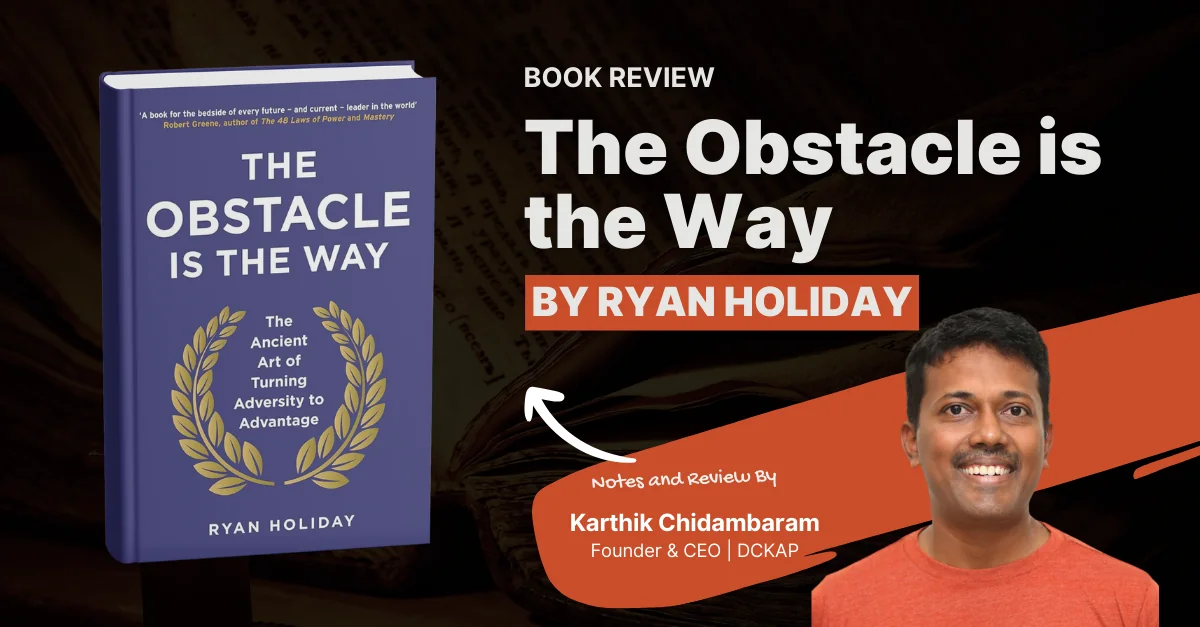
The Obstacle is the Way – Ryan Holiday
Recently, I was listening to Ryan Holiday on the Masters of Scale podcast and decided to read The Obstacle is the Way. I’d previously read one of his earlier books, Trust Me, I’m Lying, where he breaks down how the media works.
We Don’t Control External Events—But We Can Turn Them to Our Advantage
Any adverse event could also be an opportunity. Ryan lists several companies that were started during crises. John D. Rockefeller built Standard Oil amid financial crises in the 1850s and 1870s. Where others saw disadvantage, Rockefeller saw undervalued assets and bought them cheap. His calmness in crisis is a classic example of Stoic perception. GM was started in 1908 during an economic downturn. Walt Disney founded Disney during the Great Depression (1929–1930s).
The Parable of the Boulder
Once, a king noticed that his people had grown complacent and entitled. To test them, he placed a massive boulder in the middle of the main road leading into the city and watched from a distance. Most passersby simply complained—some even complained about the king—walked around it, or gave up entirely.
One day, a determined peasant arrived. He tried to move the boulder, failed at first, but didn’t give up. He explored his surroundings, found a sturdy branch to use as a lever, and finally pushed the rock aside. Beneath it, he discovered a hidden treasure and a note from the king: “The obstacle in your path is not a wall, but the way forward. Within every challenge lies an opportunity.”
Action Matters More Than Planning
Thinking and planning alone won’t do it. Obstacles cannot be overcome by hesitation. You must start, even if the first steps are small.
Calmness Is a Trained Discipline
“In calmness lies strength.” This wasn’t just a saying for Eisenhower; it was a leadership habit. During World War II in 1944, Eisenhower faced extreme uncertainty while planning D-Day. He remained composed, listened to advisors, and prepared for both victory and failure, demonstrating clarity, ownership, and calm leadership under immense pressure.
On his Friendship 7 mission, John Glenn (the first American to orbit the Earth) faced a potentially fatal spacecraft issue. He stayed completely calm, monitored systems carefully, and communicated steadily, showing that disciplined composure can turn crisis into success.
Learning from Lincoln
Abraham Lincoln faced repeated failures, personal tragedies, and political setbacks, yet he persisted with patience and composure. He lost several elections before eventually becoming president. He used each obstacle as a lesson, sharpening his leadership and judgment. Lincoln’s life shows that setbacks aren’t roadblocks—they’re opportunities to grow stronger and wiser.
Persistence and Perspective: The Edison Example
In 1878, Thomas Edison wasn’t the only person experimenting with incandescent lights. But he was the only one to test six thousand different filaments—including one made from beard hair—inching closer each time to the one that would finally work. This is a story of experimenting and persistence.
Holiday references how when Edison’s factory burned down, he said: “Thank goodness all our mistakes were burned up. Now we can start fresh.” When faced with adversity, most people react emotionally, but pausing for a second puts things into perspective. If you lose a client, it’s not the end of the world. In the grand scheme of things, this doesn’t matter—it’s a learning experience. A change in viewpoint can change everything.
Focus on the Present
Stoicism teaches focusing on the now. The present moment is what we can control.
Sometimes the Solution Is Simpler Than You Think
Oftentimes we look for the perfect solution to get from Point A to Point B. The author shares a story from 1915 where two American fruit companies tried to acquire the same 5,000 acres of valuable land. However, two different locals claimed to own the deed to the plantation. No one could tell who the rightful owner was, so the land couldn’t be bought traditionally.
The first buyer was United Fruit, a powerful corporation in the United States. The second was a small upstart owned by Samuel Zemurray. United Fruit sent out lawyers and spent a lot of money trying to find out who the rightful owner was. Samuel Zemurray? He paid both claimants for the land and bought it. He paid twice, but secured the land.
Final Lessons
To do great things, we need to be able to endure tragedy and setbacks. Sometimes a problem needs less of us—just stay calm. We need to learn to find joy in everything that happens, good or bad, or convert the obstacle into an opportunity. Sometimes we’re even better off leaving the obstacle as is and coming back to it later. We need to practice cheerfulness even in dark times. Difficult things take time—you need patience.
You don’t want a serious crisis to go to waste. If you look at history, some of our greatest leaders pushed through negative events to drive reforms forward.
My Take on the Book
I’m thankful for reading this book. My key learning is to stay calm and turn every obstacle into an opportunity. Look at every crisis, every obstacle as an opportunity. What can you learn from it? How can you leverage it to your advantage? Hard things take time, but persistence matters and things will fall in place.


Leave a Reply