
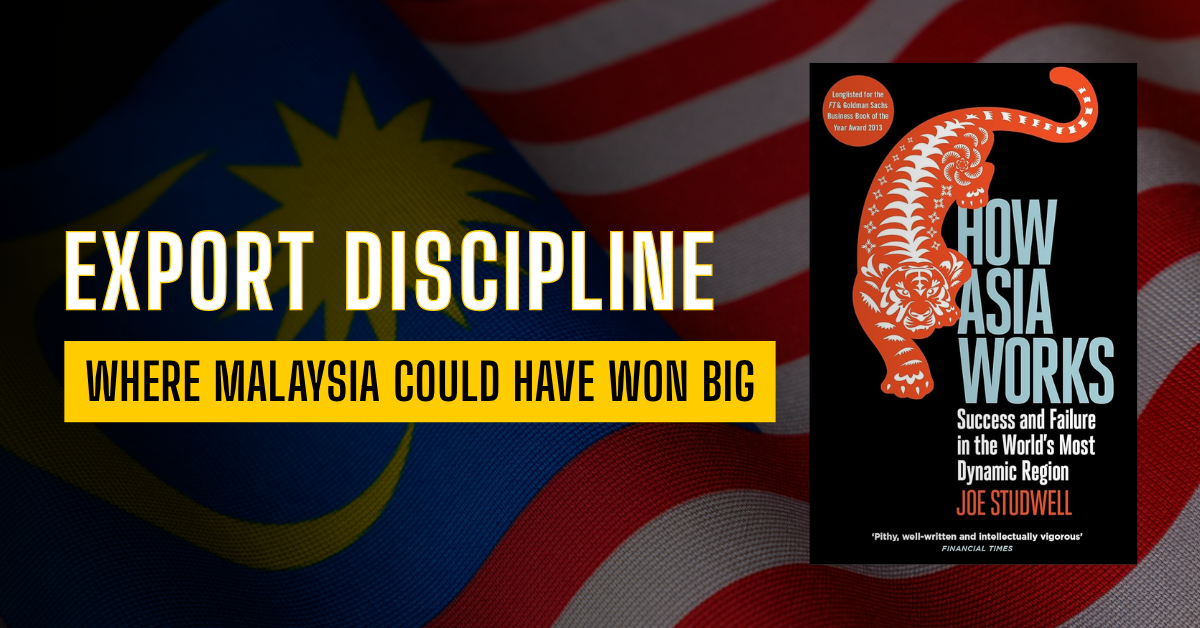
Export Discipline: Where Malaysia Could Have Won Big
Growing up in Tamil Nadu, India, Malaysia always felt like a land of abundance to me. My grandmother’s sister had migrated there, probably in the 1960s or 70s, and owned rubber estates. The trip my grandmother made to visit her was her first and only international trip. And when she returned, she brought back gifts that confirmed what I already believed: Malaysia was rich, prosperous, and something to aspire to.
I even remember following the name Mahathir Mohamad (their then Prime Minister) with a certain reverence in the late 1990s.
Later, in the late 2000s or early 2010s, I had a stopover in Kuala Lumpur and was surprised to find myself underwhelmed. My initial reaction was, ‘Maybe India isn’t so far behind.’
That impression has been sharpened considerably by Joe Studwell’s How Asia Works.
Via: Apple Books
The export discipline problem
Studwell’s central argument is deceptively simple: countries that industrialized successfully, i.e., South Korea, Japan, Taiwan, did so because they forced their manufacturers to compete in export markets.
(I wrote more about the South Korea story in a previous edition of the Hustle.)
Exporting is brutal. You can’t hide behind a protected domestic market when foreign buyers have a dozen alternatives. That pressure forces companies to get better, faster.
Malaysia, under Mahathir, had many of the right instincts. The country had its own car manufacturer — Proton Waja — and Mahathir actively encouraged entrepreneurs.

Source: Seattle Times | Mahathir Mohamad: Malaysia’s longest-serving Prime Minister
But a critical ingredient was missing: export discipline.
Malaysian companies were never really pushed to prove themselves internationally. Without that pressure, accountability evaporated, and crony capitalism filled the vacuum.
Studwell is blunt: Mahathir wanted to do everything himself — conceive the strategy, conduct the due diligence, and cut the deals. That’s not industrial policy; that’s a one-man show.
His Japanese and Korean counterparts did not share the real secrets of their protectionist strategies, and Mahathir was left trying to replicate that form without a key understanding of what made it tick.
The Korean contrast
Studwell holds up Korea as the counter-example. State-backed steel company POSCO was built behind tariff walls on imported steel in a classic protectionist move.
But the protection was conditional.
Korean companies like Hyundai (HMC) were expected to acquire foreign technology, master it, and then export aggressively. HMC didn’t just license technology from abroad; it internalized it and eventually began originating its own.
Warren Buffett’s Berkshire Hathaway eventually bought into POSCO’s equity, while Kia also eventually followed a similar path.
The lesson Studwell draws is that protectionism works, but only when paired with accountability. Shield a company from competition long enough for it to learn, then expose it to the world. Malaysia had the shield but skipped the accountability.
The racial dimension
There’s another layer to Malaysia’s underperformance that Studwell doesn’t shy away from.
Mahathir’s policies were explicitly structured to favor the Bumiputera majority over Chinese and Tamil immigrants — communities that, historically, had been deeply embedded in Malaysian commerce and manufacturing.
Studwell argues that this exclusion was economically self-defeating. Engaging those communities fully could have produced very different outcomes. When a country’s industrial policy is filtered through racial favoritism rather than meritocratic discipline, talent and capital leak away.
A note on India, And the books leaders read
Studwell doesn’t spare India either. He acknowledges the genuine success of TCS, Infosys, and the broader IT services boom, but points out that the sector employs only about 3% of the Indian workforce.
Services, however impressive, cannot substitute for manufacturing at scale. The deep employment and technological learning that come from making things from “learning by doing” on a factory floor is irreplaceable.
There’s one detail in the book I found unexpectedly fascinating.
Studwell notes that Mahathir was a vocal champion of Kenichi Ohmae’s The Borderless World: a book that argued nations should embrace open markets and that the era of the nation-state as an economic unit was fading. If you were reading Ohmae, you were in Mahathir’s good books.
But Studwell sees this as a telling symptom: Mahathir was operating on a philosophy fundamentally at odds with what actually worked. The countries that industrialized successfully did so through strategic, disciplined protectionism — the exact opposite of borderless thinking.
It’s a small detail, but it stuck with me. The books a leader reaches for shape the policies they build. Ideas have consequences, especially at the national level.
What I’m still thinking about
Mahathir ruled Malaysia for more than twenty years. The results, as Studwell frames them, are mixed at best. That’s a sobering thought. Twenty years is a long time to frame industrial policy and still have room for improvement.
Indonesia and Korea, Studwell notes, faced similar problems — no export discipline, no real manufacturing foundation. But Indonesia hasn’t yet achieved the kind of transformation Korea managed.
I hope you found this helpful and would love to hear your perspective as well.
Thank you for reading.
Karthik Chidambaram.


Leave a Reply