
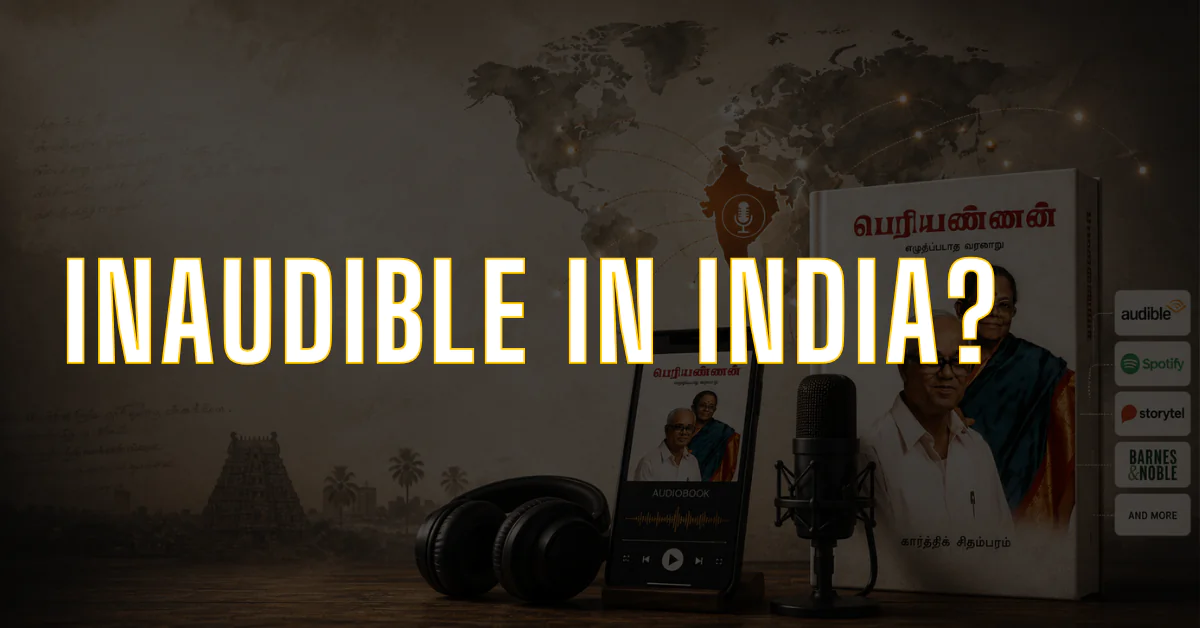
InAudible In India?
On how hitting (self) publish on an audiobook ended up being a year long journey with many more steps than we anticipated.
Periyannan – The History That Was Never Written was published as a Tamil book in September 2025.
We then decided to produce an audiobook so that the content could reach Tamil-speaking audiences who prefer listening, particularly audiences in India and the Tamil diaspora. Our initial plan was to make the audiobook available across major platforms such as Audible, Spotify, Storytel and other digital audiobook marketplaces.
We were particular about getting it on Audible because it is one of the world’s largest audio storytelling platforms and is part of Amazon. Audible currently serves members in 180 countries, offers content in more than 50 languages, and has a catalogue of more than one million titles across audiobooks, podcasts and Audible Originals.
In 2025 alone, listeners consumed nearly 6 billion hours of content globally on Audible. Audible’s scale has also grown rapidly. The company reported that its global member base grew by nearly 800% between 2015 and 2025.
The assumption was that, once the audiobook was professionally recorded and the required audio and cover assets were ready, we would be able to upload the files to the major platforms and make the title available to listeners.
However, when we explored Audible, we discovered that the most obvious direct publishing route, ACX (Audiobook Creation Exchange), is not currently available to publishers based in India. ACX has country eligibility restrictions, with direct participation currently limited to countries such as the US, UK, Canada and Ireland, which meant that we could not simply create an ACX account from India, upload the Tamil audiobook and publish it directly on Audible.
It is important to distinguish this from a Tamil-language or Indian-publisher limitation.
The problem is that Audible’s direct self-publishing infrastructure through ACX is not currently accessible to publishers based in India.
An Indian publisher can still distribute an audiobook to Audible, but it has to use an eligible distribution partner or aggregator that provides a route into the Audible ecosystem.
Because of this restriction, we worked with Clever Fox to navigate the distribution process. Clever Fox used INaudio as the aggregator and distribution platform, which provided the route through which the audiobook could be submitted to Audible as well as other audiobook retailers.
The resulting distribution chain was therefore:
Us → Clever Fox → INaudio → Audible / Other Retailers
What initially looked like a straightforward publishing activity consequently became a multi-step distribution process involving a publishing partner, an aggregator, platform-specific requirements, metadata and asset preparation, submission, review and marketplace processing.
The entire process took almost a year for us, before the audiobook was available in the marketplace. The time was not necessarily because the book was in Tamil; rather, it was the result of the combination of India’s lack of direct ACX eligibility, the need to work through an intermediary, aggregator processes, retailer-specific requirements and the review and processing timelines of the individual marketplaces.
This experience made us realise that there is an important distinction between being able to create native-language content and being able to independently distribute that content at scale. Producing the Tamil book was within our control, recording the audiobook was within our control, and we owned the content and rights, but getting that audiobook directly into the global digital distribution ecosystem was considerably more complicated.
A creator should ideally be able to produce a book or audiobook in Tamil, retain the rights, upload the content, provide the required metadata and assets, and distribute it directly to the marketplaces where the intended audience exists.
In our case, rather than the simpler model we initially expected:
Create → Record → Upload → Publish
The journey was closer to:
Create the book → Publish the Tamil book → Record the audiobook → Identify the distribution route → Work with Clever Fox → Use INaudio → Submit to Audible and other retailers → Complete marketplace reviews and processing → Wait for availability
The Periyannan experience is therefore useful as a case study of a broader challenge in native-language publishing. The content itself is not the primary barrier; the greater friction lies in the infrastructure around publishing, distribution, marketplace access and self-publishing. For Indian-language creators, particularly independent publishers who do not have the distribution infrastructure of large publishing houses, these additional layers can add several months to the time it takes for content to reach its intended audience.
The key question for us is therefore not only “Can we create good Tamil content?”, but also “Can a publisher from India independently take that Tamil content from creation to a global audience without having to navigate multiple intermediaries and platform-specific restrictions?”
Periyannan ended up being not just an audiobook project, but also a practical demonstration of the gaps that still exist in the digital distribution infrastructure for Indian-language content.
Thanks to Srija Santhanam, for writing/documenting this and navigating through this process.
You could listen to the audio book on Spotify. You can also find the book on Amazon and Barnes & Noble.
Thank you for reading.
Karthik Chidambaram.




Leave a Reply